
At least a couple of Chinese military helicopters were spotted flying close to the un-demarcated Sino-India border in the area after the fierce face-off on May 5 following which a fleet of Sukhoi-30 jets of the Indian Air Force too carried out sorties there, the sources said.

China must start taking an of late "pushy" India seriously as it has strategically placed itself in the United States-China face-off to gain maximum benefits, a leading official newspaper has said.
The remarks by the Chinese foreign ministry came a day after Secretary of State Mike Pompeo assured India that the US stands firmly with it to confront threats to its sovereignty.

India's decision to heed to Australia's request to be part of the mega naval drill comes in the midst of growing strain in ties with China over the border row in eastern Ladakh.

The Chinese technical hold was set to lapse on Monday, and had China not raised further objection, the resolution designating Azhar as a terrorist could stand passed automatically. The hold has been extended for another six months.

The editorial in the Sena mouthpiece 'Saamana' also said those who used to blame Jawaharlal Nehru for defeat in the 1962 Sino-India war should now introspect.
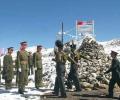
Many of them sustained minor injuries in the clash near Naku La in the Sikkim sector along the Sino-Indo border on Saturday
Chinese Foreign Ministry spokesman Wang Wenbin said this at his media briefing as he parried questions on India's assertion that consensus reached by the leaders on maintaining peace along the border cannot be swept under the carpet.
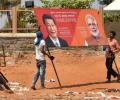
Government sources also said there was no question of any discussion on the issue as it is India's sovereign matter but added that Modi will update the Chinese President on the matter if there is a query.
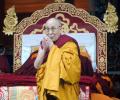
The papers said India is using the Dalai Lama as a "diplomatic tool" against China for its "vice like veto" against India's membership in the Nuclear Suppliers Group and United Nations ban on Jaish-e-Mohammed chief Masood Azhar.

The Indian delegation, comprising several officers and soldiers of the army, attended the celebration following an invitation by the PLA.

Chinese President Xi Jinping on Wednesday praised Prime Minister Manmohan Singh's contribution to the improvement of Sino-India relations.

'We are witnessing a spectacle of breathtakingly creative diplomacy at work, riveted on the firm foundations of the country's strategic autonomy,' says Ambassador M K Bhadrakumar.
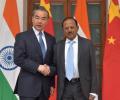
The two sides have already held 21 rounds of talks under the framework of SR dialogue which was set up to find an early solution to the border dispute.

India and Italy inked 15 pacts and finalised an ambitious action plan to further expand their ties following a virtual summit between Prime Minister Narendra Modi and his Italian counterpart Giuseppe Conte that primarily focused on ramping up economic engagement.

On Day 2 of the summit, Modi and Xi held a fresh round of one-on-one discussion at the Taj Fisherman's Cove Hotel.
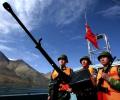
Both the Indian and Chinese armies have brought in more troops in sensitive locations like Demchok, Daulat Beg Oldie and areas around Galwan river as well as Pangong Tso lake in Ladakh, the sources said. The area around Galwan has been a point of friction between the two sides for over six decades.
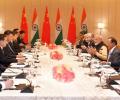
The prime minister started off his remarks at the meeting in Tamil, welcoming China to the talks, which were held right after one-on-one discussions between Modi and Xi at the Taj Fisherman's Cove Hotel.

The talks are taking place in the backdrop of China blocking at the United Nations India's move to get Jaish-e-Mohammad chief designated as international terrorist. Doval is expected to raise this issue with Yang.

One thing Beijing must understand is that India is not obsessed with being a threat to China but only wants a rightful place for itself in the world, says Sanjeev Nayyar.
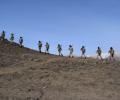
On May 5, around 250 Indian and Chinese army personnel clashed with iron rods, sticks, and even resorted to stone-pelting in Pangong Tso lake area in Eastern Ladakh.

Modi also said the people of India felt proud that President Xi has twice received him out of the capital.

Answering questions on the clashes near Naku La Pass in the Sikkim sector which resulted in injuries to both sides, Chinese Foreign Ministry spokesman Zhao Lijian said that the most pressing issue for the world at present is the fight against the coronavirus.
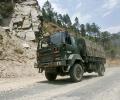
It is learnt that Defence Minister Rajnath Singh has conveyed to top military brass that there was no need for reviewing the implementation of any of the key projects along the Line of Actual Control (LAC) in Ladakh, Sikkim, Uttarakhand or in Arunachal Pradesh in view of the aggressive behaviour by Chinese troops in several sensitive areas.
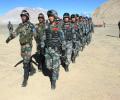
Indian and Chinese troops remained engaged in an eyeball-to-eyeball situation in several disputed areas.

Sticking to its stand that McMahon Line on India-China boundary is "illegal", China on Monday said it is ready to work with India to resolve the vexed border issue at an early date through "friendly consultations" to create more favourable conditions for bilateral ties.

India said a new mechanism will be set up for issues relating to trade and investment.

Sources had earlier said Modi and Putin would also deliberate on impact of US sanctions on import of crude oil from Iran.

The Wednesday talks took place amid a war of words between the two sides on perception of the LAC, the de-facto Sino-India border spanning a length of nearly 3,500 km.

President Pranab's four-day visit to China that saw him meeting the top Chinese leadership and discussing the sticky boundary issue and cooperation in combating terrorism besides the need for a predictable nuclear regime.
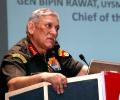
'We should not treat each other as rivals. We should make cooperation the mainstream, China said.

The visit by Gen Rawat, Ajit Doval and Vijay Gokhale was the first such high-level trip from India to Bhutan after the Doklam standoff.

China also said that it was opposed to any third-party involvement in the resolution of the Sino-India boundary disputes.
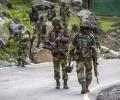
The sources said there was clear sign of withdrawal of structures and troops from the patrolling point 14 in Galwan Valley and that they are likely to move back more than a kilometre in the area.
Playing down President Barack Obama's visit to India, official media in Beijing on Wednesday said too much need not be read into the "romance" between him and Prime Minister Narendra Modi as there are difficult talks ahead before both sides' expectations can converge.

The US wants to split Sino-India ties, says the Chinese media.

This will be the first visit of Mukherjee to China as President though he has visited the country a number of times in different capacities. The last Presidential visit to China was by Pratibha Patil in 2010.
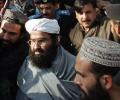
China on Thursday said it was in "close" contact with India over its efforts to put Masood Azhar on the United Nations list of proscribed terrorists, as it expressed willingness to step up bilateral counter-terrorism cooperation in response to President Pranab Mukherjee's call.
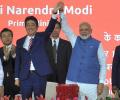
Chinese foreign ministry spokesperson Hua Chunying, while reacting to Japan's plans to step up investments in the northeastern states, told the media that China is opposed to any foreign investment in the areas where it has disputes with India.

There is enough scope for India and China to cooperate on nuclear energy issues despite the lingering issues which not only includes the Sino-Pakistan nexus, but also the Sino-India border dispute over the LAC, says Debalina Ghoshal.
